On the Ethics of Ambiguity
There is a passage early in Simone de Beauvoir's The Ethics of Ambiguity where she describes the child's world as one of "serious" values--fixed, given, beyond question. The child inhabits a universe furnished by adults, where meaning is handed down like furniture. It is only later, in adolescence, that the scaffolding shudders and the young person is confronted with what de Beauvoir calls the "agonizing moment" of discovering that the world has no pre-given justification. That the values propping up your existence were, all along, contingent.
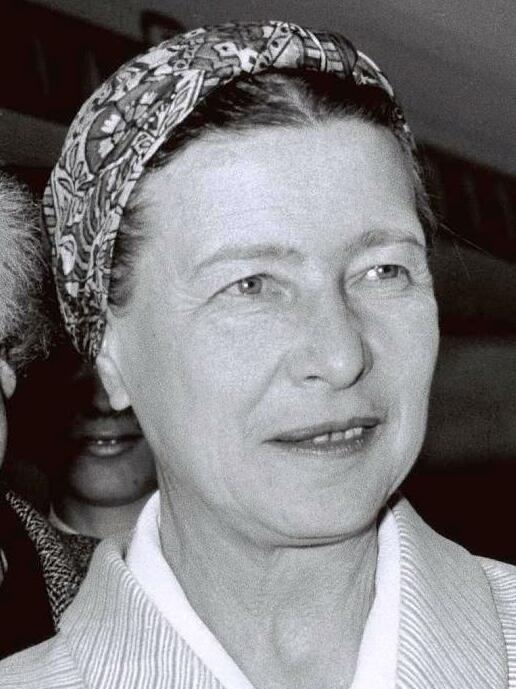 Simone de Beauvoir, whose existentialist ethics remain as uncomfortable--and necessary--as ever
I read this book for the first time at twenty-two, and I remember the recognition was physical. Not the comfortable recognition of finding your own opinions reflected back at you, but the queasy kind--the feeling of being caught.
The Taxonomy of Bad Faith
De Beauvoir's project in The Ethics of Ambiguity is to build an existentialist ethics on the foundation Sartre laid in Being and Nothingness--but where Sartre left us with a kind of dizzying, vertiginous freedom and not much guidance on what to do with it, de Beauvoir attempts something more systematic. She asks: given that we are radically free, given that existence has no pre-given meaning, how ought we to live? And more pointedly: what are the ways we fail to live?
Her answer takes the form of a gallery of defective attitudes--portraits of people who, in various ways, refuse the full weight of their freedom. These are not straw men. They are, if you are honest with yourself, people you have been.
The Sub-Man is the figure who flees from his own existence. He does not assert, does not choose, does not risk. He lets the world wash over him. De Beauvoir describes him as living in a kind of stupor, a "state of blindness and ignorance." He is not evil--he is something worse in the existentialist framework: he is inert. He has abdicated the defining feature of human existence. We all know this person. Many of us have been this person, particularly in the years right after the scaffolding collapses and the vertigo sets in.
The Serious Man is more interesting, and more dangerous. He is the one who, confronted with the abyss of freedom, immediately fills it with an external value--a cause, an institution, a career, a god. He treats these values as given, as objective, as absolutes that exist independent of any human choice to affirm them. The serious man is the company man, the ideologue, the true believer. His bad faith consists in denying that he chose his values--in pretending they were always there, immovable as bedrock.
De Beauvoir is devastating on this point. The serious man's devotion is a dodge. His commitment is real, but his understanding of it is false. He has confused the intensity of his attachment with the objectivity of its object. And when his chosen absolute crumbles--as absolutes always do--he has nothing. He collapses into the next figure.
The Nihilist
The nihilist is the serious man's hangover. He is what happens when someone invests everything in an external absolute and then watches it fail. Having believed in the objectivity of values and been betrayed, the nihilist concludes that nothing has value at all. De Beauvoir calls this "the attitude of negation"--the refusal to will anything, to affirm anything, because all affirmation has been revealed as illusion.
I recognize this figure with uncomfortable precision. There is a period in most thinking young people's lives--somewhere between eighteen and twenty-five, though some get stuck there permanently--where nihilism feels not like a failure but like an achievement. You have seen through the game. You have understood, as Ecclesiastes puts it, that all is vanity. The serious people around you, with their careers and convictions and five-year plans, are dupes, and you have had the courage to face the void.
Except, as de Beauvoir points out, this is its own kind of cowardice. The nihilist has merely replaced the serious man's false positive with a false negative. He still treats meaning as something that must be given from outside--he has simply concluded that nothing is giving it. He has not yet grasped the genuinely radical point: that meaning is something you make. That the absence of objective values is not a catastrophe but a condition--the condition of freedom itself.
I spent longer in this posture than I care to admit. Not the brief flirtation of late adolescence that de Beauvoir describes, but years. The better part of a decade. The intellectual satisfaction of seeing through things is considerable, and it costs nothing. You can be a nihilist from a very comfortable chair. I was. I watched elections and wars and financial collapses with the detached amusement of someone who had already concluded that none of it mattered, that the machinery of public life was a farce performed for the benefit of people too credulous to see through it. I told myself this was lucidity. It was, in fact, the most comfortable form of cowardice available to someone with an internet connection and no dependents.
What changed was not an argument. It was the accumulation of evidence that the void I had been contemplating so serenely was filling up with something ugly. The political disintegration of the past several years--the casual dismantling of institutions, the resurgence of movements I had naively assumed were historical curiosities, the visible fraying of the social fabric in my own communities--forced a recognition that nihilism is not a spectator sport. The refusal to affirm anything is itself a political act. It clears the field for people who have no such hesitation. I had spent years congratulating myself on seeing through the game, and in the meantime the game had changed around me in ways that demanded participation, not commentary. De Beauvoir would not have been surprised. She saw it happen once already.
The Adventurer
The adventurer is the figure who fascinated me most when I first read the book, and the one I understand differently now.
The adventurer, unlike the nihilist, does not deny freedom. He embraces it. He throws himself into projects, takes risks, acts boldly. He is the existentialist hero in miniature--except for one critical failure. The adventurer treats other people's freedom as irrelevant. He is willing to use others as instruments, as scenery in his personal drama. His projects are real, but they are solipsistic. He wills his own freedom without willing the freedom of others.
De Beauvoir is clear that the adventurer's attitude is seductive precisely because it looks like authentic existence. He has the vitality, the commitment, the willingness to act that the sub-man and the nihilist lack. He appears to have overcome bad faith. But his freedom is parasitic--it depends on the unfreedom of others, or at minimum on his indifference to it.
At twenty-two, I thought the adventurer was the most sympathetic figure in the book. He was doing something. He was alive. The sub-man was pathetic, the serious man deluded, the nihilist a bore--but the adventurer had style.
It took years to understand that de Beauvoir was describing the most sophisticated form of bad faith in her catalog. The adventurer's error is not that he acts, but that he acts as though he exists alone. His freedom, unmoored from solidarity, degenerates into a kind of aestheticized will-to-power. He is, to put it bluntly, the libertarian of existentialism.
What She Is Actually Asking
The force of de Beauvoir's argument is cumulative. Each defective attitude fails for the same fundamental reason: it refuses the full implications of human ambiguity. We are free, but we are also situated. We are subjects, but we exist among other subjects. We must choose, but our choices reverberate through a shared world.
 Hannah Arendt--whose own work on freedom and action shares deep affinities with de Beauvoir's project
The genuine ethical attitude, for de Beauvoir, is one that wills its own freedom and the freedom of others--not as an abstract principle, but as a concrete commitment. Freedom is not a solitary achievement. It is, as she puts it, "achieved through the freedom of others." This is not sentimental. It is structural. My freedom is diminished in a world of unfreedom, because freedom requires a world of free others to be meaningful.
This is where de Beauvoir parts company with the caricature of existentialism as pure individualism. The ethics she constructs is fundamentally social. It demands engagement, solidarity, political commitment--not as external impositions on a free individual, but as expressions of freedom itself.
The Ghosts of Youth
Reading The Ethics of Ambiguity again at a distance of years, what strikes me is not the philosophical architecture--which is impressive but not unique--but the accuracy of the portraits. De Beauvoir understood, in a way that most philosophers do not, that ethical failure is not primarily intellectual. It is dispositional. We do not usually reason our way into bad faith. We drift into it, or we are seduced by it, or we adopt it because the alternative--the full, unprotected confrontation with our own freedom and responsibility--is too much to bear.
I can map my own trajectory through her taxonomy with embarrassing ease. The seriousness of adolescence, where the values handed down by school and family felt as solid as the ground. The nihilism of the early twenties, where seeing through those values felt like wisdom. The adventurer phase, where acting on pure appetite and calling it freedom felt like living authentically. And then, slowly, painfully, the recognition that none of these postures was adequate--that freedom without solidarity is just selfishness with a philosophical alibi.
De Beauvoir does not moralize about this. She describes. And the descriptions are so precise that they function as mirrors. You see yourself in these figures not because she is judging you, but because she has understood something about the shapes that human freedom takes when it is afraid of itself.
The Radicalization Pipeline She Already Described
De Beauvoir was writing in 1947, two years after the liberation of Paris. Fascism was not an abstraction for her. She had lived under occupation, watched her city collaborate and resist in roughly equal measure, and understood that the movement which nearly swallowed Europe was not powered by a single psychological type but by several, working in sequence.
Read her taxonomy again with this in mind and the contemporary resonance is unsettling.
The sub-man is the raw material. He is disengaged, passive, resentful in a diffuse and undirected way. He has no project of his own. He is the young man in his childhood bedroom, doomscrolling at 2 a.m., aware that something is wrong with the world but unwilling or unable to articulate what. He does not yet have a politics. What he has is a void--and voids get filled.
The nihilist is the next stage. He is the sub-man who has discovered that nothing is sacred and mistaken this discovery for sophistication. In the 1930s he was the cynic in the beer hall who sneered at the Weimar Republic. Today he is the anonymous poster who traffics in irony so thick it becomes indistinguishable from sincerity--the "just joking" that is never entirely a joke. The alt-right understood this figure instinctively. The boards, the memes, the performative contempt for all values--these are nihilism weaponized. The genius of the movement, such as it was, lay in recognizing that ironic detachment is not a terminus but a waystation. You do not stay a nihilist forever. Eventually the void demands to be filled with something, and the pipeline is ready with an offer.
The serious man receives the convert. He provides the absolute the nihilist has been missing: the race, the nation, the civilization, the "tradition" that must be defended at all costs. The serious man's bad faith is the most politically dangerous in de Beauvoir's catalog because it scales. One nihilist is harmless. A thousand serious men marching under the same banner are not. The serious man does not experience his commitment as a choice--he experiences it as a discovery, a revelation of how things really are. This is why arguing with him on the merits is so fruitless. He is not defending a position. He is defending the ground he stands on. To question his values is, in his experience, to question reality itself. Every fascist movement in history has depended on this psychology. The content of the absolute changes--racial purity, national greatness, religious destiny, "Western civilization"--but the structure is identical. An unchosen, objective value that demands total submission and justifies any action taken in its name.
And then there is the adventurer, who in the context of fascism becomes the most chilling figure of all. He is the one who does not believe. He is the leader, the opportunist, the man who manipulates the serious men because he understands their psychology without sharing it. De Beauvoir describes him as treating other people's freedom as scenery, and there is no better description of the demagogue. He wills his own freedom--his power, his project, his drama--without the slightest concern for what it costs others. He is not deceived by the cause. He is the cause's author, and the serious men are his instruments.
This is not a forced reading. De Beauvoir herself spends considerable time in the book discussing fascism, and her analysis of the "passionate man" and the "tyrant" tracks exactly this dynamic. What makes it newly relevant is that the radicalization pipeline she described in philosophical terms--from passivity to nihilism to fanaticism, with an adventurer at the top pulling strings--maps with disturbing precision onto the mechanics of online radicalization that researchers have documented over the past decade. The alienated young man who finds community in ironic nihilism, who graduates to earnest ideology, who is mobilized by a charismatic figure who does not believe a word of it--this is not a new story. De Beauvoir told it in 1947. We simply did not expect to need the warning again so soon.
Why It Still Matters
The Ethics of Ambiguity is not a long book, and it is not an easy one. De Beauvoir's prose is dense, and her philosophical vocabulary can be forbidding. But it rewards the effort. In an era saturated with competing certainties--political, technological, ideological--her insistence on ambiguity feels not like weakness but like intellectual honesty of the rarest kind.
We live in a culture that is, in de Beauvoir's terms, dominated by serious men: people who have identified their freedom with an external cause and lost the ability to see their own contingency. The tech utopians, the culture warriors, the ideologues of every stripe--all share the serious man's fundamental error. They have mistaken the intensity of their conviction for the objectivity of their values.
De Beauvoir would not tell us to stop caring. She would tell us to care differently--to hold our commitments with the awareness that we chose them, that they could be otherwise, and that they are justified only insofar as they expand, rather than contract, the field of human freedom.
That is an uncomfortable position to occupy. It offers none of the satisfactions of certainty, none of the comforts of fanaticism. But it is, I think, the only honest one.
The Banality and the Abyss
Hannah Arendt, sitting in a Jerusalem courtroom in 1961, watching Adolf Eichmann fumble through his testimony, arrived at an insight that has been misunderstood ever since. The banality of evil is not the claim that evil is ordinary in the sense of being unimportant. It is the observation that the most catastrophic moral failures do not require demonic intent. They require only the abdication of thought. Eichmann was not a monster. He was a functionary who had ceased to think--who had surrendered his judgment to a system and performed his role within it with the untroubled conscience of a man filling out paperwork. The machinery of annihilation did not run on hatred alone. It ran on compliance, on routine, on the simple unwillingness to ask whether what one was doing was right.
I think about Arendt constantly now. I think about her when I watch officials carry out policies they cannot defend in plain language. I think about her when I watch institutions hollow themselves out in real time, not through dramatic confrontation but through the quiet, cumulative retreat of people who know better but do not act on it. The banality is the point. Evil does not need to announce itself. It needs only a sufficient number of people who have stopped thinking.
And I am quite certain--not as a rhetorical posture but as a considered judgment--that there is a realized nihilism at the heart of the current administration. Not nihilism in the colloquial sense of "not caring," but nihilism in de Beauvoir's precise sense: the attitude of negation elevated to a governing philosophy. The systematic destruction of regulatory capacity, of diplomatic relationships, of scientific infrastructure, of the civil service itself--these are not the actions of people who believe in a positive project for the country. They are the actions of people who have concluded, consciously or not, that the existing order deserves to be razed, and who have no coherent vision of what should replace it. The cruelty is not incidental to the project. The cruelty is the project.
Consider Michael Anton's "Flight 93 Election" essay from 2016, the closest thing the movement produced to an intellectual justification. The metaphor is worth dwelling on. In Anton's framing, America is a hijacked plane. The passengers--the voters--face certain death if they do nothing. The only option is to rush the cockpit. "Charge the cockpit or you die," he wrote. The desperation of the metaphor was its appeal. It offered the electorate the moral clarity of a binary: act or perish.
But follow the metaphor to its conclusion, as Anton did not. On Flight 93, the passengers who charged the cockpit understood that they would probably die. Their heroism consisted in choosing to act despite this certainty, in willing the survival of others at the cost of their own lives. That is not what Anton was describing. He was not calling for sacrifice. He was calling for a gamble premised on the conviction that everything was already lost--that the country, the culture, the civilization was in terminal decline, and that any action, however reckless, was preferable to the status quo.
Extend the metaphor honestly into the present and what you get is not the passengers charging the cockpit. It is the hijackers themselves. President Trump is the captain now, just waiting for you to get inside. Armed with the full apparatus of the state, the invitation is not to save the plane but to ride it into the ground--and to take as many people as possible along the way. The animating impulse is not heroism, not glory, not any of the noble causes we have shown ourselves throughout history to be willing to die for. It is a desire to annihilate oneself and the world along with it. It is not conservatism. It is not populism. It is national socialism--not as a historical analogy trotted out for rhetorical effect, but as a precise description of a political movement built on resentment, scapegoating, the cult of a leader, and the romance of destruction.
Arendt warned us that the worst atrocities do not require villains. They require only the surrender of judgment. De Beauvoir warned us that freedom, when it refuses to acknowledge the freedom of others, degenerates into tyranny. Both women wrote from the wreckage of a continent that had learned these lessons at the cost of millions of lives. We are not entitled to the luxury of learning them again.