
We remember Nixon as the man who resigned in disgrace and waved from the helicopter. That is the version that outlived him, and it flattens a much stranger figure. Garry Wills wanted the whole man, including the parts that make him hard to hate cleanly.
The tragic hero of American politics
Garry Wills’s Nixon Agonistes (1970) is the political biography I keep going back to, and not because it flatters its subject. Wills takes Nixon seriously as a man rather than a punchline, treating him as a figure who carried the contradictions of postwar American conservatism around in his own body. He wrote the book before Watergate, which matters more than it sounds. Wills had no downfall to reason backward from. He read the character straight, and the character told him where it was going.
The title echoes Milton’s Samson Agonistes, the blind strongman brought low, laboring and suffering in plain sight of the people who once feared him. Wills is warning you up front that this is a book about struggle as a permanent condition, about a man who never stopped straining against something, usually the people whose acceptance he wanted most.
Beyond simple villainy
Wills refuses caricature. What he offers instead is a man assembled out of resentment and appetite who also happened to be one of the shrewdest politicians of his century. The Nixon who emerges is neither monster nor martyr. He is something more uncomfortable: a mirror held up to American anxieties about class, striving, and who gets to count as authentic. Wills calls him, in effect, the best and worst of the country compressed into one man, and the phrase only earns its weight once you see the argument beneath it. Nixon’s virtues and his vices ran on the same machinery. The relentless self-making, the certainty that he had earned everything and been handed nothing: that is the striver’s creed, and it is also the exact wiring of his paranoia. You cannot cut out the ugliness without losing the drive. That is what makes him tragic in the old sense rather than merely unlucky. The flaw and the greatness grow from one root.
The Checkers speech is where Wills makes this concrete. In 1952, accused of keeping a secret slush fund, Nixon went on television, walked the country through his modest finances, name-checked his wife’s “respectable Republican cloth coat,” and refused to return the one gift he admitted taking, a dog named Checkers his daughters loved. It worked. It saved his place on Eisenhower’s ticket. But Wills sees more than a slick escape. The speech is a founding document for a whole style of politics, the middle-class man performing his own ordinariness as a credential and turning an accusation into an audition for the audience’s sympathy. Nixon is not really defending himself. He is inviting resentful people to recognize their own besieged decency in him. The grievance is the pitch. Decades of conservative rhetoric would run on that same current, the feeling that ordinary strivers are forever being condescended to by their betters, and Nixon found the frequency first.
The liberal consensus and its discontents
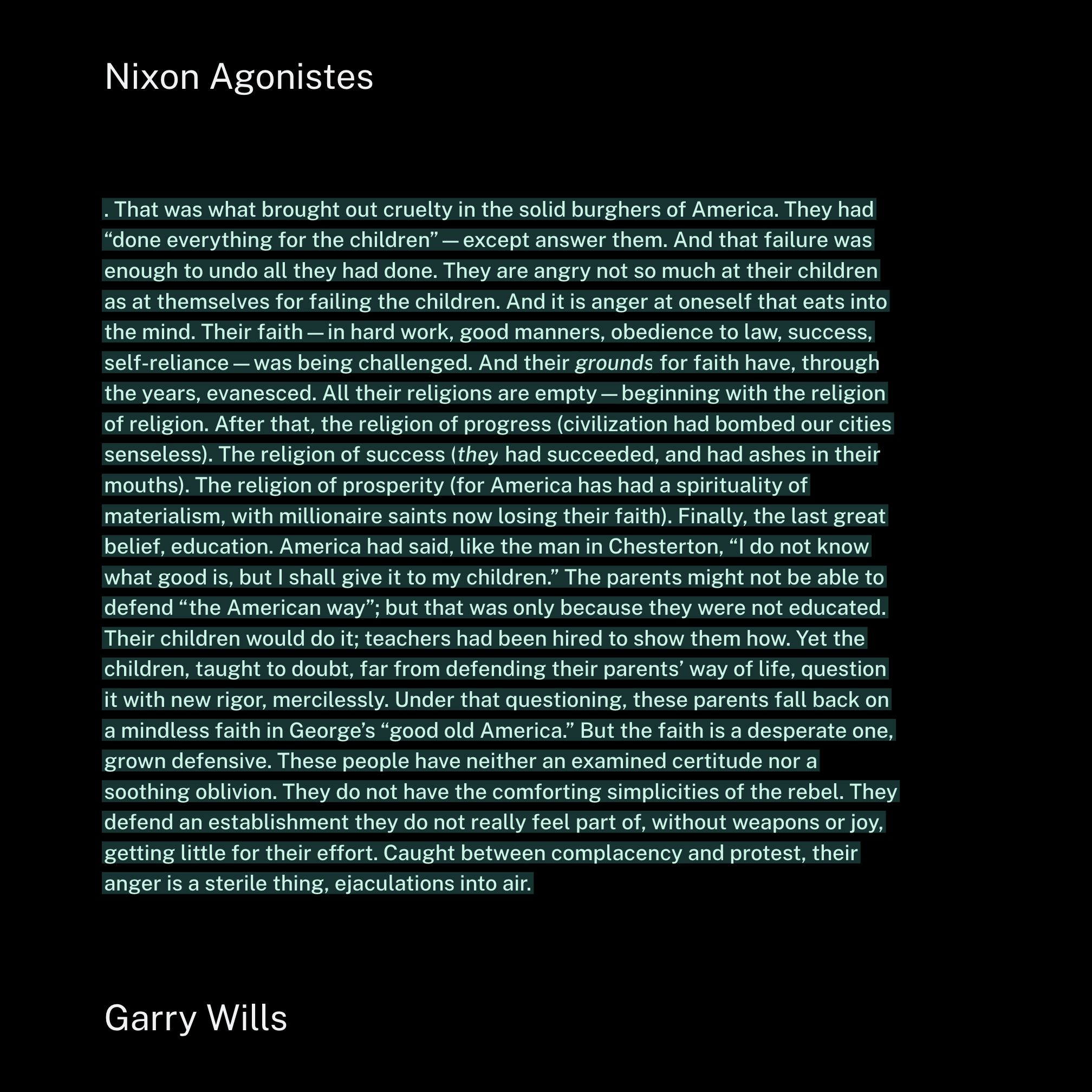
One of my favorite passages comes when Wills sits in on a rally for George Wallace and studies the crowd he names the “comfortable discontented.” These are not the wretched of the earth. They are people doing fine by most measures who still feel cheated, and Wills is precise and a little merciless about the forces bending their thinking. It may be the sharpest stretch in the book on where the coming realignment would draw its fuel.
The larger argument is about the “liberal consensus” that governed American politics through the 1950s and into the 1960s. Wills’s reading is that Nixon both challenged that consensus and belonged to it completely. He ran as the outsider, the grocer’s son from Whittier with his nose against the glass of the Eastern establishment, and he wanted nothing so badly as to be let inside. That tension organizes his entire career: populist resentment aimed at the elite, welded to a desperate hunger for the elite’s approval. He attacked the club and spent his life auditioning for membership.
Wills traces how Nixon rode the breakup of that consensus, from the anti-communist crusades that made his name to the Southern Strategy that remade his party. He sees clearly, and early, how deliberately Nixon fished the racial and cultural resentments the 1960s had loosed, and how that catch would reshape American politics long after the man himself was gone. Reading it now, with those fault lines only wider, is unsettling. He was diagnosing the machine while it was still being bolted together.
Style and substance
Wills writes with a literary range that political biography rarely reaches. The classical allusions never curdle into showing off. He has a reporter’s eye for the detail that gives a scene away and a philosopher’s patience for what the detail means. The structure follows its subject, moving among biography, political analysis, and outright philosophy. It asks something of the reader. It also pays you back, with observations a more conventional life of Nixon would never stumble into.
How we got this Nixon
Written before Watergate, Nixon Agonistes reads as though it already knows how the story ends. Wills names the paranoia, the grievance, and the will to power that would eventually pull the presidency down around Nixon, and he names them as character rather than prophecy. He spends real effort explaining how this particular Nixon got built and which forces pressed him into shape.
The most interesting stretch is Wills’s dissection of American liberalism itself. His argument, as I read it, is that liberalism rests on a faith in open competition, a marketplace of goods, of opinions, and of political power in which everyone supposedly meets on equal terms and the best rises to the top. Wills’s point is that the equal playing field is a fiction. It has never existed, and given who already holds the advantages, it cannot. Liberalism keeps promising a fair race while the starting lines stay exactly where they have always been, and that broken promise is precisely the opening Nixon and Wallace worked. The resentment they harvested was not irrational. It grew in the gap between what the consensus said it was offering and what it actually delivered.
I will admit to being a Wills partisan, and the prose is a good part of why. There are pages here I have gone back to just to watch how a sentence is put together. In our own season of grievance politics and permanent polarization, the analysis reads less like a period piece than a warning that showed up fifty years early. Nixon’s weaponized resentment, his war on the media, his coded appeals: the playbook is depressingly familiar.
Minor criticisms
The density is real. Wills assumes you already know your mid-century American politics, and his philosophical detours, rewarding as they are, do slow the story down. Some readers will be unsettled by how much sympathy he extends to Nixon. For me both are the point. The last thing we need is another biography that files a human being down into a caricature for the archive. Lincoln has suffered this fate a hundred times over, and nearly every life of him fails to reckon with the actual complexity of the man. Nearly every one. Lincoln at Gettysburg, by this same author, is the exception, and it is the best case for why a portrait that refuses to flatten its subject tells you more than a hundred cleaner ones. Wills does for Nixon what he would later do for Lincoln. He trusts the contradictions instead of sanding them off.
Fifty years on
I keep coming back to Nixon Agonistes for Nixon himself, and for the liberalism he grew up inside. Wills shows how private psychology, political calculation, and historical pressure all met in one difficult man. Journalism written to a deadline that hardened into something people still argue with.
If you want to watch American conservatism travel from Eisenhower’s caution toward today’s populist revolt, or how private wounds get turned into public movements, start here. More than fifty years on, the book still works.
A word on the rating: I don’t hand out top marks often, and I usually have a caveat ready. This is one of the few books I would put in someone’s hands without one. Read it.
One of an ongoing series on Garry Wills. The rest are under the Garry Wills tag.