
Christopher Lasch died in 1994, which is inconvenient, because he wrote the best book about 2025 and nobody else has managed to since. He was a historian at Rochester, a man of the left who spent his career irritating the left, and he did most of his real work before the internet, before Trump, before Brexit, before the phrase “the algorithm” meant anything. Read him now and the timing feels off in the other direction. He isn’t predicting our moment. He’s describing it, in detail, from thirty years away.
That’s the thing I miss. Not the prose exactly, though the prose is good. What I miss is having someone that serious who could not be sorted onto a team.
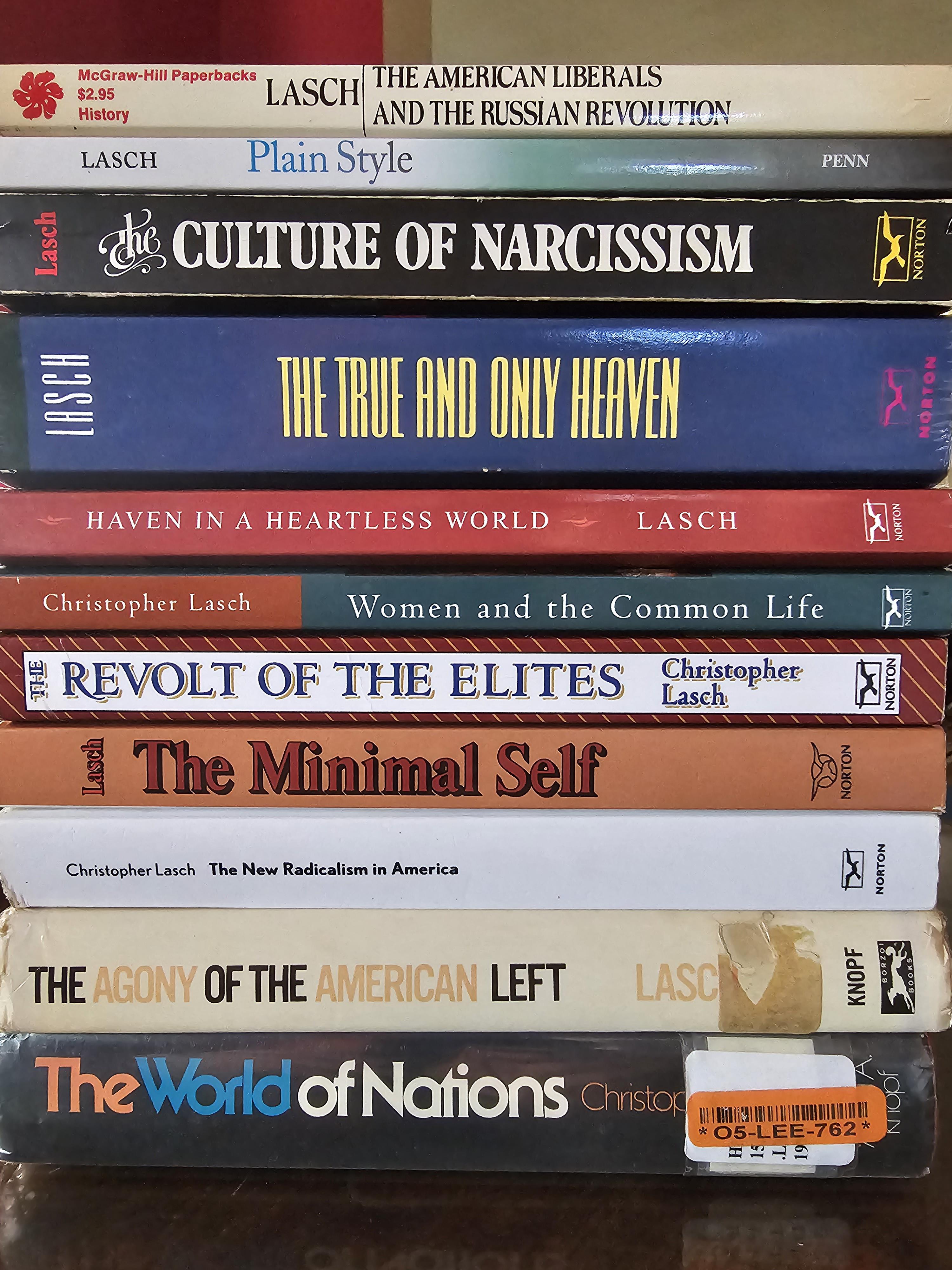 A stack of Lasch that still earns the shelf space
The one idea he wouldn’t let go of
Lasch distrusted progress, and never stopped. Not progress in the sense of penicillin or plumbing, which he was fine with, but progress as an ideology: the assumption, baked into both parties and most of respectable opinion, that history runs one direction and our job is to get out of the way. In The True and Only Heaven: Progress and Its Critics he took that assumption apart, and the surprising move was where he went looking for the critics. Not to conservatives defending old hierarchies. To the small proprietors, the artisans, the populists and syndicalists, the people who wanted a stake in something and were told by their betters that wanting a stake was backward.
Faith in endless expansion, he argued, quietly eats the things a decent life is built on. Once you believe there are no limits, self-restraint looks like cowardice, obligation to a place looks like provincialism, and the idea that a person might owe something to neighbors he didn’t choose starts to sound faintly embarrassing. Left and right both signed up, in their own dialects. The right got there through the market, which promises that infinite growth will sort everything out. The left got there through liberation, which promises that shedding every inherited tie is the same as freedom. Different vocabularies, same destination: a citizen reconceived as a consumer, of goods or of identities, and a public life hollowed out to make room.
He had already named the result in an earlier book. The culture of narcissism was not, in his telling, a country of vain people admiring themselves in mirrors. It was something colder. As families and neighborhoods handed their functions off to experts and agencies and the state, people were left managing an anxious, brittle self with no thick web of relations to rest it on. Self-absorption wasn’t a moral failing so much as the default setting of a person who has been relieved of the burdens that used to give a self its shape. That is the part that reads uncomfortably now, in an economy that has monetized exactly that anxiety and sells it back to us hourly.
The revolt he actually saw coming
The book that earns the “written about right now” reaction is his last, published the year he died: The Revolt of the Elites and the Betrayal of Democracy. The title is a deliberate theft. In 1930 Ortega y Gasset had warned about the revolt of the masses, the fear that swamped the interwar imagination, that the vulgar many would rise up and drag civilization down to their level. Lasch turned it over. By the end of the century, he argued, the danger came from the top. It was the winners who had revolted, and what they were revolting against was the rest of the country.
He described a new elite defined less by a bank balance than by a way of life. Mobile, credentialed, at home in airports and conference hotels, more fluent in the concerns of their counterparts in London or Singapore than in the lives of people forty minutes down the highway. He called them tourists in their own countries, and the phrase still lands because it names something real: a class that consumes a nation without quite living in it. They had removed themselves from common life by degrees, into what he called voluntary ghettos of the successful, gated neighborhoods, private schools, private security, private medicine, until the public institutions that once mixed the classes together had become the places you used only if you couldn’t afford to opt out. The secession was quiet and it was total, and because it wore the language of merit it never had to call itself what it was.
He pressed hardest on merit, and there he loses the most friends. Meritocracy, to almost everyone, is the good version, the fair alternative to inherited privilege. Lasch called it a parody of democracy, and the parody is precise. Democracy rests on a wager that ordinary people are broadly competent to run their own affairs. Meritocracy replaces that with a sorting machine that skims the talented out of every town and ships them upward, and then congratulates them on having earned their exit. It doesn’t abolish the class divide. It launders it, and it adds a moral insult the old aristocracy never bothered with, the suggestion that the people left behind are there because they deserve to be. The result is contempt in one direction and resentment in the other, and a professional class that has convinced itself its advantages are the wages of virtue.
From there the public square degrades on schedule. When the terms of debate are set by people who share a class, an education, and a set of unexamined assumptions, argument narrows to the questions that class finds interesting and dismisses the rest as ignorance or bigotry. Lasch thought democracy needed argument the way a body needs exercise, that you find out what you actually believe by having to defend it to someone who doesn’t already agree. Take that away and you get what we have: not deliberation but posturing, each side performing certainty for its own audience, nobody expecting to be moved and nobody trying to move anyone. His title doesn’t name a single act. It names the slow withdrawal of the people best equipped to sustain a common life from the work of sustaining it.
Why he still stings
Line all this up against the present and it stops being theory. The populist wave, Trump and Brexit and their European cousins, is exactly the return address Lasch’s argument predicts: a large part of the country deciding that the people who run things neither know nor care what their lives are like, and reaching for whoever will say so out loud. You don’t have to admire the figures who caught that wave to notice they were catching something real. The grievance was manufactured by decades of secession before any demagogue thought to name it.
The economics fit the same frame. A billionaire funding private rockets while the bridges rust, a founder preaching disruption to workers who can’t disrupt their own rent, these aren’t hypocrisies Lasch would have been shocked by. They’re the secession of the successful, rendered in cash. And the collapse of trust in institutions, the media, the universities, the agencies, is not mostly a communications problem, whatever the communications departments think. It’s people accurately sensing that the institutions belong to a class that has checked out, and returning the indifference. Even the culture war has a Laschian shape. Strip away shared standards and a common life, and what’s left is a war of enclaves, each tribe barricaded inside its own reality, which is close to the thing he was afraid of when almost nobody else was looking.
What keeps him from being just another declinist is that he offered his own side no exit. This was a man of the left telling the left that its faith in liberation had helped build the machine, that its educated professionals were the seceding elite, that its contempt for ordinary people’s attachments to family and place and faith was not enlightenment but a class marker. He indicted the right too, harder in some ways, but the right was never going to read him. He wrote the uncomfortable book for the people least willing to hear it, and he did it without the consolation of a program. He didn’t have five policies to fix this. He had a warning, and the warning was that the fix, if there is one, would demand things the modern self is organized to refuse: humility, self-restraint, the acceptance of limits, some real obligation to people you share a country with but would never choose.
That’s why I miss him, and why the missing has an edge to it. Not because he was right about everything, he wasn’t, and parts of him curdle into a nostalgia I don’t share. I miss him because he was the rare critic who would turn the knife on his own, who understood that the point of thinking is to arrive somewhere you didn’t want to go. We have no shortage of people willing to indict the other team. What we’ve lost is the willingness to be the skunk at your own party. Lasch spent thirty years doing exactly that, and he’s been dead for thirty more, and the party has only gotten worse.